

By Paul Hamby
PAUL HAMBY: There are a lot of crazy stories about what happened to Stanley Littleboy.
MICKEY MASCARENA: That guy, he did not like staying in the house.
PAUL: Some of the craziest ones come from his daughter, Mickey Mascarena.
MICKEY: He got hit by a car one time. I don’t know exactly what time, if it was the first time or the second time. I just know that he got hit by the cars a lot and he had broken legs and we had to go get him. And so he’s like, I’ll go stay out in the shed. I’m like, no, dad, it’s too cold. You have to stay inside. And the only way we could get him to stay inside was we had to have alcohol there, right? So my husband went and got a big bottle ’cause he wouldn’t take his pain meds. So our household was full and my dad was staying with us and we were all working and it was so cold… And when we all get off of work, we’re like, hey, where’s, where’s dad? Hey, where’s Stanley?
PAUL: He’d run off – on his broken legs. Another time, Mickey found him after a bullet went through one side of his face and out the other.
MICKEY: He’s like, I got shot in the face. I was like, what? let me look. And you could see the holes in his mouth and you could see like when he opened it, you could see the little casino lights and everything on the other side. And he laughed. He thought it was so funny. We go, oh my gosh, Dad just come home with us. I went to go use the bathroom. Once again, he ran away.
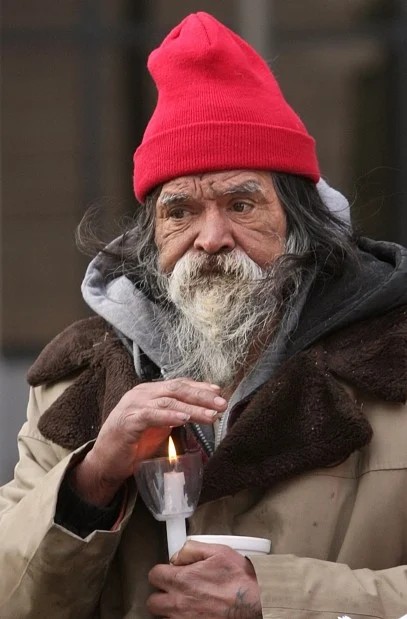
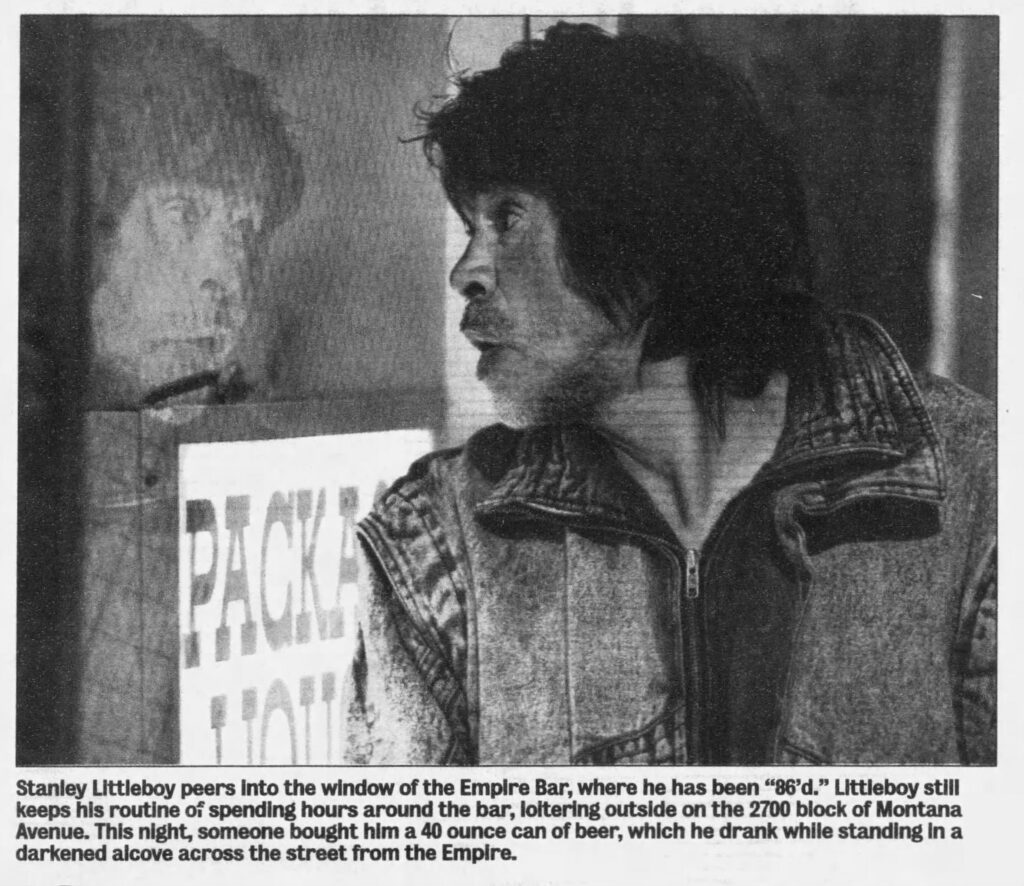
PAUL: Those were two lives down, seven more to go for the man known as “El Gato.” Like a lot of people in downtown Billings, I knew of Stanley Littleboy for years, but I didn’t learn who the man actually was until he died. The Billings Gazette building was in the path of Stanley’s loop around town, which took him from the South Side neighborhood to Downtown, and across the railroad tracks that bisect the two areas. Going in and out of my job as a reporter at the Gazette, I’d catch Stanley in various states of mobility; – on two feet, shuffling forward with his weight on his walker or seated in a wheelchair, using his legs to inch his way from block to block. I’d say hi and I’d get a quick nod. If he was wheelchair-bound, I’d offer to give him a push and save him some effort… and he’d wave me off. For my first four years at the paper, up until I learned his name, I only knew Stanley by his look, he wore layer upon layer of stiff, stained clothes, a floppy beanie and a full beard. Stanley had a gaze that stuck with me, two small dark eyes set in tufts of greasy, gray and black hair. It felt a bit cruel to compare his look to that of Charles Manson, so I always likened him to an urban Santa Claus.
When I finally did learn Stanley’s name, it was from the county coroner.
In February 2024, sheriff’s deputies found a body in a ditch along the railroad tracks east of Downtown. I was on the public safety beat at the paper. That meant it was my job to find out who this man was and how he died – and whether or not the cops suspected ‘foul play,’ as they’d call it. The article I put together only took a couple of hours to write and maybe two minutes to read. It ran with a great photo taken a few years earlier by our staff photographer. But it was missing who Stanley really was. I didn’t know where to start. I found out he was part of the roll call that happened at South Park – it’s a morning meeting where people living on the streets show up and be counted. And through the comments on Facebook, I also learned about Stanley’s adult children. Mickey Mascerena and Anthony Littleboy have kids of their own now. They were all in Billings – all in and out of each others’ lives over the years. Stanley Littleboy wasn’t a homeless man without a family. But his hard way of living made him a hard man to love.
MICKEY: How do you show love when you were never taught love?
PAUL: The first time I spoke with Mickey, she’d just finished a snowman with her kids at South Park. That was her dad’s favorite spot and it had been a year since Stanley had died. Their snowman was a tribute to him. He wore a bright orange beanie he might have worn on his rounds. They’d made a beard out of a mop and they rubbed coffee grounds into it to grime it up. And also right there, tucked underneath this mop beard, was an open can of beer. I wanted to know about Stanely Littleboy – about more than his death and the way people around town knew him. Mickey was willing to talk about him and about her life, too. We set a date when it was warmer to meet back up where her dad and his buddies did their roll call. She showed up with her brother, Anthony, and his two kids. Mickey and Anthony were raised near here in South Billings.
ANTHONY: My mom made some sacrifices for us to have a home. ‘Cause the first home that our dad … that’s when he got with my mom. He told her, I have my own place. And she’s like, oh, okay. Come to find out, it was like a closet.
MICKEY: We’re eight years apart. Yeah. My mom definitely wanted another kid and so, ’cause I guess I was always by myself, so she, she, we had my brother.
PAUL on tape: Do you like being an older sister?
MICKEY: I guess. I mean, I had to grow up fast.
ANTHONY: Us kids had to raise ourselves, learn how to cook … My sister started driving when she was seven, eight years old.
MICKEY: Six.
ANTHONY: Six. Six and taking care of all of us.
PAUL on tape: Sitting on phonebooks? How did that work?
MICKEY: Three pillows on the back, and three pillows on the bottom. My mom had a big, old car. So…
PAUL: One of Mickey’s earliest memories of her dad was seeing him outside, working without his shirt on
MICKEY: I remember being a kid and he was doing yard work.
PAUL: It stuck out because of all the scars her dad had – even then.
MICKEY: He lived a very rough life. And he was stabbed in the stomach with a machete. And when I’d see other gentlemen doing yard work, I was like, there was something wrong with them because they didn’t have that scar on their stomach.
ANTHONY: He had the bullet in his face, the stab on his neck, the ax to his back. And people would say that, yeah, our dad could fight, I mean, take a beating, but to survive through our home? No, he could not.
MICKEY: Isn’t that weird? He could survive out here with that kind of lifestyle, but in a home to be like, you know, an actual partner I guess, or something like that? Couldn’t do it.
ANTHONY: He could not do it.
MICKEY: He couldn’t.
PAUL: He could walk off a gunshot wound and he could bounce off the hood of a car and keep going, but he couldn’t live with his kids and take care of them. He could hustle enough money to feed himself and his brothers, but he couldn’t commit to staying with his kids’ mom. He’d gladly have a beer with his kids, but shirked any of their attempts to get their dad to open up about his past, or talk about his feelings. His biggest commitment was to live outside. That was his choice.
MICKEY: He said he liked to live off the grid. He liked to be free.
PAUL: Mickey grew up taking care of herself and her little brother, sitting on stacks of pillows to see over the steering wheel. Anthony had to wait till his teens for his dad to even acknowledge him as his son.
ANTHONY: And he always called me “Boy. Hey boy, hey boy.” And my mom would always tell him, that’s your son. He’s all, no, that’s a boy. That’s a boy. And for many years, I grew up with hate. It was kind of embarrassing at that age too, ’cause I mean, all my friends had their dads and stuff living in their house and stuff. And what could I say about my dad? He’s a homeless guy. It was not easy growing up with that.
PAUL: When he was around 14, Anthony met up with Stanley in this park. It was a conversation he’ll never forget.
ANTHONY: I mean, my dad never considered me as a son. At this park we’re in, over here at the gazebo and he finally accepted me. He gave me a big hug, told me, “Hi son,” this and that, and I drank a couple beers with him. Shocker. There I was only 14 years old, but we got to talking and stuff and, you know, straightened out some things. Pretty much after that…
PAUL: And pretty much after that… Stanley stayed off the grid. But it was different between them.
ANTHONY: He lived a life still out here and I could not live that with him. He wanted me to go stay at his camp area, but I couldn’t. I’m not much of a, well, a sleeping out here person.
PAUL: Mickey and Anthony have spent a lot of years trying to figure out their relationship with Stanley. But before they were born, Stanley spent a lot of years dealing with his own family troubles. His life started on the Turtle Mountain Indian Reservation in North Dakota and he moved to Montana when he was a kid. From there, there are some gaps with how things fell apart. He ended up in the state orphanage. Technically, the place was called the Montana Children’s Center in Twin Bridges. It closed in 1975. Now its big claim to fame is being featured as an episode on the HBO show “Ghost Adventures.” For Stanley and others – especially Indigenous kids – some dark things happened there. But he wasn’t alone there. Several of his relatives also ended up at the orphanage, including his cousin, George Littleboy.
MICKEY: George and my dad, they were raised more like brothers. I actually have him on Facebook. I could introduce you real fast if that’s okay.
PAUL on tape: Absolutely.
MICKEY: I’ll try calling him. … Hi, Uncle George. How are you? [George on tape] I’m tired. Mickey: I could see that. Um, there’s a reporter here that’s doing the story on my dad and he was just wondering if there’s some time that you feel up to it, would you be able to maybe share some stories about Dad when you feel better? He said no hurries
PAUL: George that day had gone in for dialysis. About a week later, I met up with Mickey and her family at her home and she dialed up Uncle George again. I was trying to find out how he and Stanley and others in their family ended up at the orphanage – how it was to be sent to this place with all these rules and if that could maybe throw some light on how Stanley decided to live his life. George kind of talked about how they ended up there.
GEORGE: We were a little bit too wild for the city life, so we got sent away.
PAUL: I pressed him a bit on what life was like there. Stanley’s kids had told me that he didn’t like talking about it. George didn’t like talking about it either.
GEORGE: Kind of makes me sad to talk about it. The scars were deep after we got out of Twin Bridges. A lot of deep scars.
PAUL: What he would say is that he felt taken care of by his own people there, even if the people who were supposed to take care of them – including the staff at the orphanage – failed to do that. George was the last of the family to leave Twin Bridges. He followed his cousin Stanley back to Billings. And they kinda got back to being wild.
GEORGE: We’d stay in cars and under abandoned houses. He taught me that. And how to survive on the streets, go out, hustle in pool or something, you know, so we could get something to eat. He used to be a pretty good pool player. You know, if we scored, we’d always help feed each other. And if one of us got a job, sometimes the other would, and we’d take care of each other. Yeah, we did spend some hard times together, but he sure pulled me through a lot of tough times, Stan did.
PAUL: George eventually moved west to St. Ignatius, where he retired as an irrigation systems operator. When they became men, and George had a career, a home and a family, he tried reaching out to his cousin, asking him if he wanted help.
GEORGE: He didn’t want it when we tried to give it to him.
PAUL: At the park, Stanley’s kids talk about the way their dad grew up, how maybe that’s what made him a fighter.
ANTHONY: He, it’s always, uh, him about being a warrior, how to survive out here. Like, “I’ve been shot. I’ve been, uh, fighting since I was young” and this and that. And, and we, we ain’t gonna lie, he has the scars to show it.
PAUL: Like the world’s toughest steel, Stanley was torched, twisted and pressed. His kids say his resilience taught them resilience, too. But it also taught them how not to live the way their dad did. And even though they knew he was ornery and wouldn’t change, they cared enough about him to keep on trying to give that to him – to give him a roof and a home. Mickey and Anthony had three priorities on the rare occasions they convinced Stanley to stay with them: Get him a haircut, burn his clothes and most important, give him a bath.
ANTHONY: It was like treating, like a 5-year-old. We had to hold him down and clip him. And he’d forget some privacy things, you know. My sister had a husband and I had a fiance back then, and he’d forget to knock, he’d forget the meaning of being polite and, you know, respect.
PAUL: Mickey’s husband is Donovan Mascarena. I met him, too. He’s been a big part of trying to get Stanley to settle down and clean up. At first, he didn’t believe half the stories his wife told him about her dad. Then he met the man.
DONOVAN MASCARENA: And that night, he made an impression on me. You know, of course, because we had to party to keep him here. And we were sitting here chit-chatting, and he goes to light this cigarette. And I remember he lights that up and his mustache just, boom! Because there was so much alcohol. It looked like those guys that breathe fire. So he starts slapping his face. He goes, “I hate when that happens.”And I’m like, Stanley, ‘When that happens??’
PAUL: On another night, one of Stanley’s brief stays with Mickey and Donovan or Anthony, they asked if we wanted to join family movie night.
ANTHONY: But the only problem is he never watched movies ever in his life, I believe. So one time we made him watch “300.” That guy made that 300 into a 3,000 movie because he watched it every day. He was a proud warrior like them.
MICKEY: I don’t think we’ve watched it once since our dad passed away because
ANTHONY: He burned, he burned us out on that.
MICKEY: Definitely burnt out on that one.
DONOVAN: I think that’s the character he emulated. That strong warrior: ‘I’m a provider but I don’t provide much.’
PAUL on tape: Spartan living.
DONOVAN: Right, Spartan living, yeah. … But there was still a soft man in there. It took a lot of alcohol to get him out, but you can get him out. You can get that soft spoken man and you would hear gentle stories and good times, and a lot of war stories, but you would hear that soft person in there.
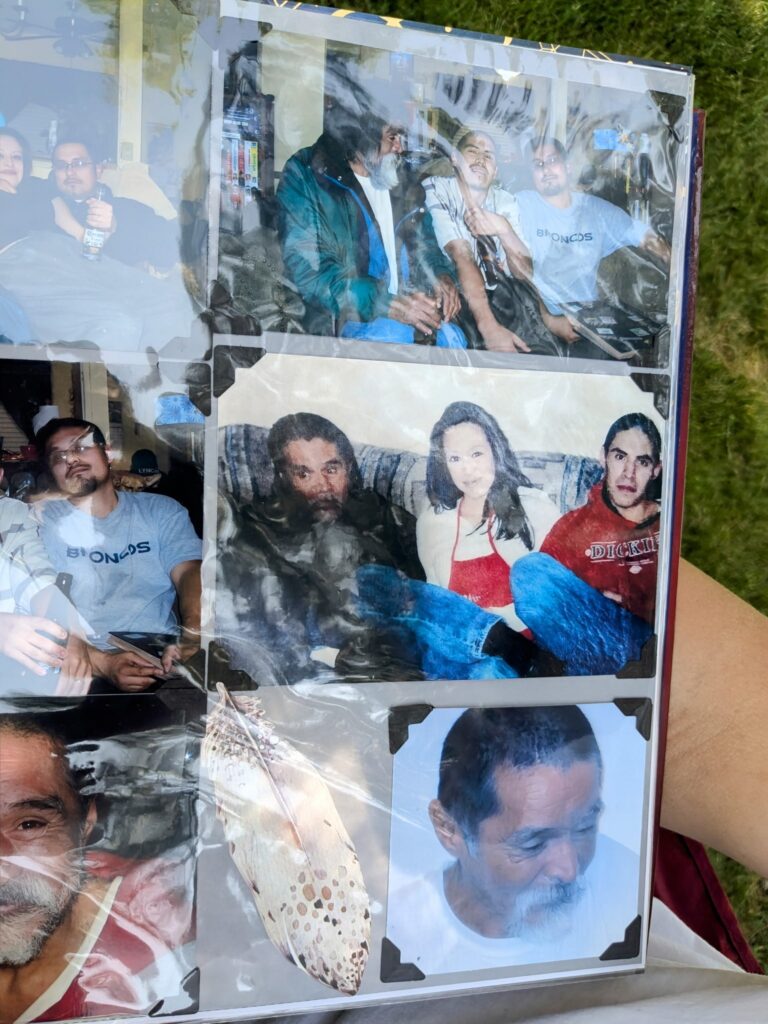
PAUL: The soft person in Stanley tried to show his kids that while he may have been absent for a lot of their childhood, they weren’t forgotten. Even when he was in jail, he’d send his kids letters and artwork, bright pieces of a creative mind. When they met me at South Park, Mickey brought along a scrapbook packed with photos of Stanley dating back to his time at the orphanage, to years later when he lived in Billings and sported a glorious mustache. Among the photos are bits of artwork, twisting ribbons and bright hearts.
MICKEY: He was really good at shading.
ANTHONY: Yah, shading. …
MICKEY: Really good with with, like, flowers, The jailhouse way, I guess you could say. Saran Wrap, you could do wax, you could do all kinds of, to make it pop out. He was really good with nunchucks. He knew how to play the harmonica. Him and his cousins, when they would get together, my uncles, they all kind of knew their own thing, you know, one could play the guitar, another one could do the tambourine, one was the harmonica. That man had a lot of talent. He knew how to do a lot, a lot of things, a lot of things he knew how to do. And not trying to be disrespectful when I say this, but he kind of just pissed it away.
ANTHONY: For many years, me and my sister, we had a lot of anger growing up. And our mom told us that you can’t have anger in your heart ’cause it’s gonna just kill you slowly by slowly.
MICKEY: I think once you let go of your anger and your demons, you don’t let them get the best of you. Because sometimes your mind will get the best of you, you know? Beause you can start getting those thoughts. Once you start letting that go, that’s when you start accepting. And then the next thing you get is possibly a friendship or some kind of decency with each other. And that’s where we got with our dad after all that.
PAUL: They got there through a lot of effort. And losing him the way they did, it softened them a bit, too. They arrived in the park wearing t-shirts made for Stanley’s memorial – dominated by his weathered, bearded face, the photo that ran with his obit.
MICKEY: He told me, the worst part about getting old is that you’re alone. I was like, Dad, I don’t know what you want me to do. He would always tell me and my husband and my brother, ‘When is it my turn? When is it my time to go? When is it? I’m tired of living this life.’ And we’re always trying to give him a different one because you said you’re tired of it, so let us help you try and make it a different one for you. It may not be the greatest but…
PAUL: An EMT crew found Stanley Littleboy’s body several miles east of his usual stomping grounds on the South Side. He was partially buried in snow and wearing hardly anything to protect him from freezing temperatures.
ANTHONY: And my sister took it the roughest. And I had to be the strongest out of the guys in the family to stand up for my, for my dad and do the speech for him and for all the family.
PAUL: At his memorial service, Mickey and Anthony were surprised by how many showed up. They greeted dozens of people they didn’t really know – including members of their dad’s street family. Stanley left behind all these people – along with a few pieces of artwork and a dollar bill – they’re all in Mickey’s scrapbook now. Instead of a coffin, mourners got a final look at one of Stanley’s walkers, painted in white.
MICKEY: And what got me through my dad’s death was my husband told me, he’s like, he’s always said this, he’s always, he’s always wanted it. He’s just like, just remember, remember the last time we seen him, he was in the sun. He was trying to get warmed up. And he’s like, when he looked up, he saw all his family members up there and he just said, finally the big party in the sky. And that’s what got me through all of it.