

By Bayliss Flynn
BAYLISS FLYNN (on tape): “Can I squeeze past you? Thank you.”
BAYLISS: I’m in an old shed behind this one-story house. There are maybe three other people in here with me. We’re all here for this estate sale – you know the kind. It’s when anyone can show up and paw through people’s things, usually after they die. Honestly, I’m a big fan of these kinds of sales. You can find a lot of cool stuff. This shed we’re checking out is made of bricks – there’s a doorway separating two rooms, but it doesn’t have a door. It’s dusty and almost totally dark – although there’s a bit of gray daylight coming in from the open door. You can smell the mustiness of it. There are boxes on the floor, boxes stacked on top of each other. I start looking through them, finding what you think you’d expect – old checkbooks and calendars. I check inside these old-school metal lockers and find a bunch of paperbacks with mountain men on the covers and some Boy Scout pamphlets.
Then I open up this metal file cabinet, expecting to see old tax documents or insurance policies.
Instead, I find this manila folder. Inside is a stack of old black and white photos and I start thumbing through them. Then I register what they are – these truly shocking images on glossy paper. The first is of this woman wearing a sleeveless dress. Her dark hair is short and curled and she’s lying on stark-white hospital bed. The dress has this big black stain on it. It takes me a minute to realize, it must be blood. Her arms and legs are also spattered. One eye is open, the other’s swollen shut with blood trailing down her cheek. Holding these photos in this shed makes me keenly aware of my body. I can feel the blood rushing to my hands. In a different photo, a different woman. She takes up most of the frame, sprawled on dark 70s shag carpet. She’s wearing a long sleeve floral pajama top, but it’s ripped open, completely exposing her bare chest. A knife is sticking straight out of it between her breasts. Her eyes are open and staring off to the side, but lifeless. Needless to say, this isn’t what I expect when I’m looking for knicknacks at an estate sale.
Why are they here? Just stuck in this folder in this shed where anyone can flip through them, even take them home? Instead of taking them myself, I take a few pictures of them on my phone. When I get home, I show my roommates, and there’s a big audible gasp.
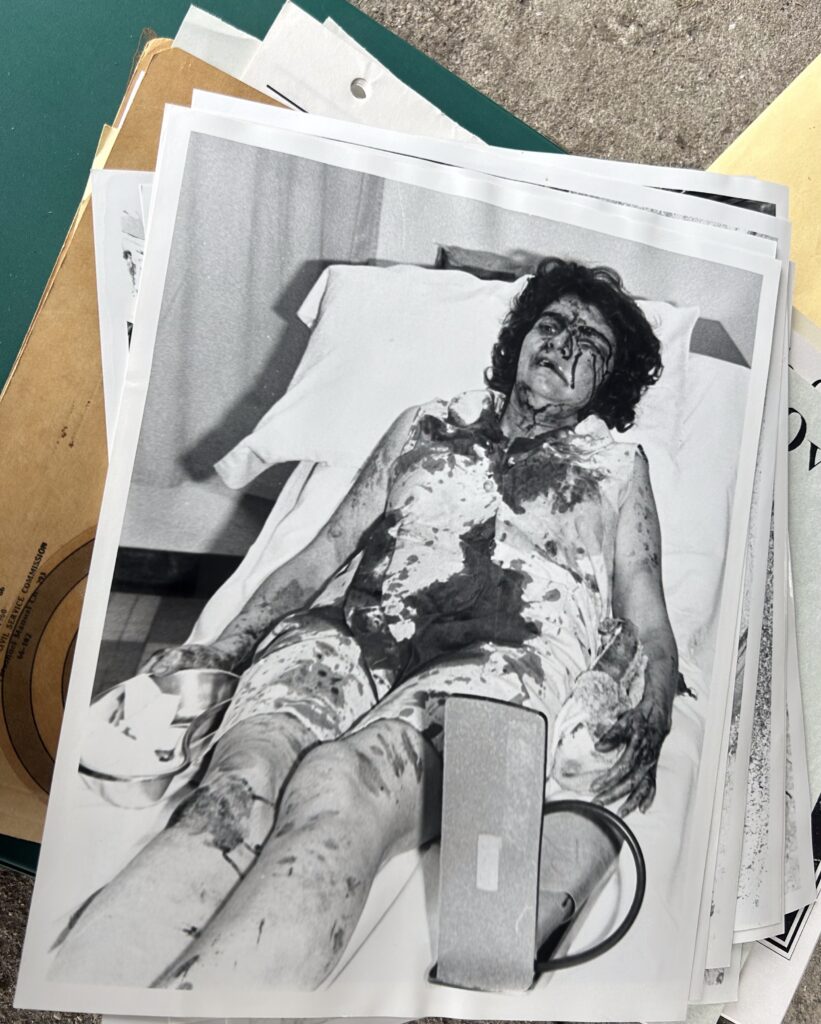
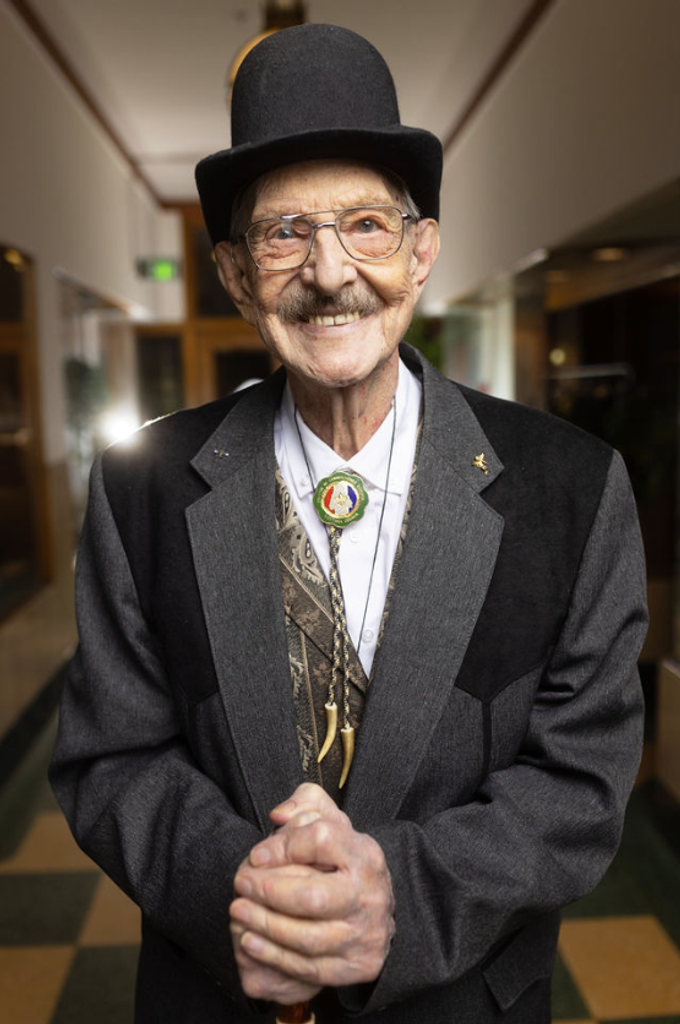
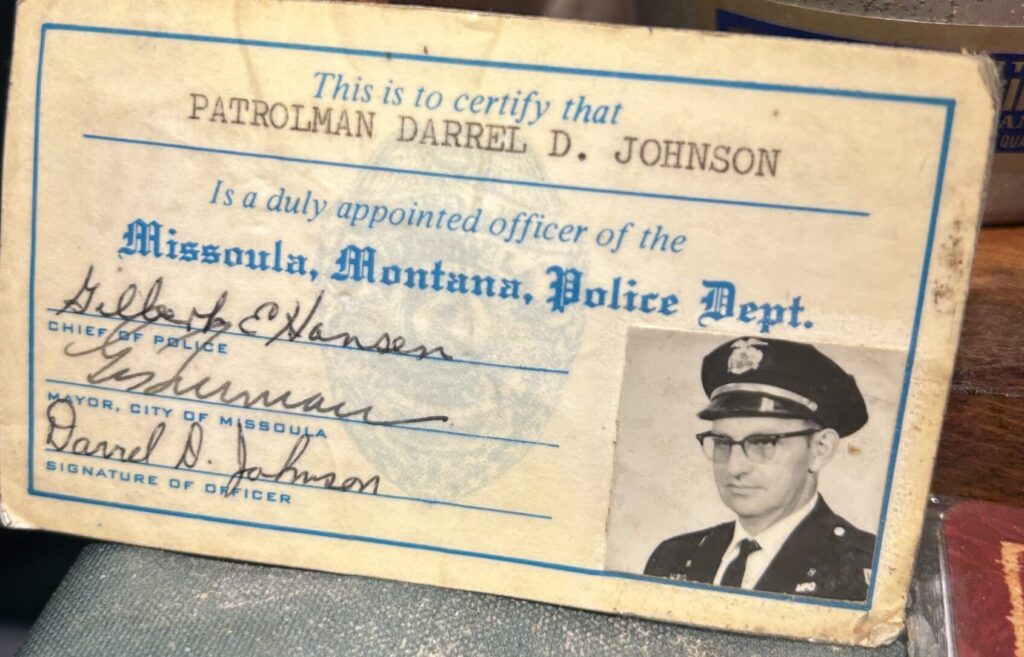
The photos were shocking to me, too, but finding them in the shed made some sense to me. I actually know a lot about the guy who took these photos. His name is Darrel Johnson, and I’ve been working on an obituary about him. This shed was his workshop. It’s behind his house on the Northside of Missoula. And he was not a serial killer. He was a cop. Although, at least one of the cases he worked *was* about a serial killer – the notorious Wayne Nance, who was known as the Missoula Mauler. These photos are connected to that case – they could be. They appear to be from that era. But there’s no label or info with them. Still. I’m pretty sure Darrel took them because I know he was a crime scene photographer. And because the Missoula police department didn’t have a dark room then, Darrel would take his film home to develop it. He probably hung up these bloody, gruesome photos to dry in the only bathroom in the house. Darrel worked as a city cop or a sheriff’s deputy in Missoula for 33 years. But a cop’s not all he was, of course. His obituary photo on a funeral home website shows an older guy in a fancy bolo tie – he’s also got on a top hat, a definitely Western suit coat and a vest. The obituary paints a picture of this rugged man with an affinity for the Old West. It says he was a Mountain Man who loved black powder muskets. It mentions a Dutch oven cookbook he wrote for a program called “Becoming an Outdoors Woman.” There’s a great quote in this obit about a guy born 100 years too late – It says, “Darrel wanted to live in those days, not just read about them.”
As I started asking around about Darrel, I found out he wrote this obituary himself. That gave me a pretty good idea of how Darrell wanted to be remembered. But that made me question: who was he really? I wondered about this cop who was into coonskin outfits and Dutch ovens – but who also kept these gruesome photos in a folder for 50 years. I talked to all kinds of people who knew Darrel – a couple of his coworkers, his son, his granddaughter in law, his grandson, his great-grandson. He was a different Darrel for each one of them. Like we all are, right? Everyone knows us in their own way. I’m a college soccer goalie with teammates. I’m a journalism major with classmates. I’m my parents’ daughter and a friend to my friends. And I’m also someone standing in this shed, kind of excited about finding these photos of murdered women. What I found out in talking to people about Darrel Johnson is that Darrel, maybe more than most, was really a man of contradictions.
Let’s start with Doug. Doug Chase is a former sheriff, and he worked with Darrel at the Missoula Police Department for about 20 years. I met him, his wife and their French bulldog at their charming house in the Rattlesnake neighborhood. And he was ready to roll with some Darrel stories.
DOUG CHASE: We worked many, many things together, and he was huge compared to me. I was nothing but a tiny, tiny guy, but he had a heart of gold..
BAYLISS: He and Darrel worked a lot of high school dances. They’d show up in uniform to keep the kids in line.
DOUG: And one time it was a Sadie Hawkins dance. So I got into my uniform, and I came to Sentinel High School, and Darrel was my partner. And the next thing I look up and he’s in a coonskin cap and full leathers from the old days. I mean, he was just unbelievable. And he had a ball and cap pistol instead of his regular. I mean, he just floored me. He was just that kind of guy. You never knew what to expect.
BAYLISS: So on the night of that dance, Darrel got a tip that three guys were on the roof of the school, trying to break into the automotive shop through some windows.
DOUG: So Darrel went up there. I didn’t know about it, but Darrel went up there. Can you imagine three young men with their face on the windows, looking down into the shop, figuring out how to get in? And here’s this guy in the coonskin cap, full leather and his badge pinned to his chest, and nailed them all and brought them all down, and that was the end of that because they had learned one big lesson. You never know who is going to catch you, or how they’re going to be dressed.
BAYLISS: At dances and sports games, Darrel would handcuff couples together for a laugh. Doug says about five times just how big Darrel’s hands were, that he could bring you down to your knees with just a handshake.
DOUG: But boy, when he grabbed you by the arm and told you you were under arrest, you were a dummy if you tried to resist him, and he placed you in handcuffs and Darrel had them all wrapped up, like a Christmas present in nothing flat. That’s just the kind he was.
BAYLISS: He was tall, about six-three. But Doug says he was kind of a big ole teddy bear.
DOUG: I don’t think there was a mean bone in his body.
BAYLISS: But also? He could be a teddy bear with some bite.
DOUG: He would not pass up the chance, if it didn’t hurt somebody’s feelings, he would not pass up the chance to get to you or get at you. If he knew it’d hurt you, he’d never done it. If he thought your feelings would be hurt. Most people didn’t want to mess with Darrel, though.
BAYLISS: Doug knew Darrel as a coworker. He says he rarely saw him outside of work but he knows from experience most cops bring their work home. And he assumes Darrel did, too.
DOUG: It was just you saw the worst of people. You saw the worst of scenes, you saw shootings, you saw terrible car accidents. It was a tough time back in those days, and you had to carry it with yourself. There was no counseling. You were on your own. Let’s face it, half of the nation’s police officers have been divorced.
BAYLISS: So there was a strain on families
DOUG: and there was never a strain on Darrel’s that I know about.
BAYLISS: But I found out that’s not exactly true. I talked to Darrel’s son, Monte Johnson. We met up at his house outside Kallispell. When I arrived he had a bunch of Darrel’s things laid out. He thought looking at them would help him talk about his dad. And as we chatted about Darrel, Monte became more and more open about what it was really like to grow up with him.
MONTE JOHNSON: He’d have good times and bad days. Bad days, you just kind of let him do his own thing out in the garage. Being in law enforcement all those years was … it’s rough. You see, a dark side of society, and your family wonders if you’re coming home tonight or not. They take it personally at times. So they kind of start developing a certain kind of callous that the family sadly gets to that part of that callous as well. And, you know, it can be really tough on a family. The family doesn’t always—I don’t know how to say it.
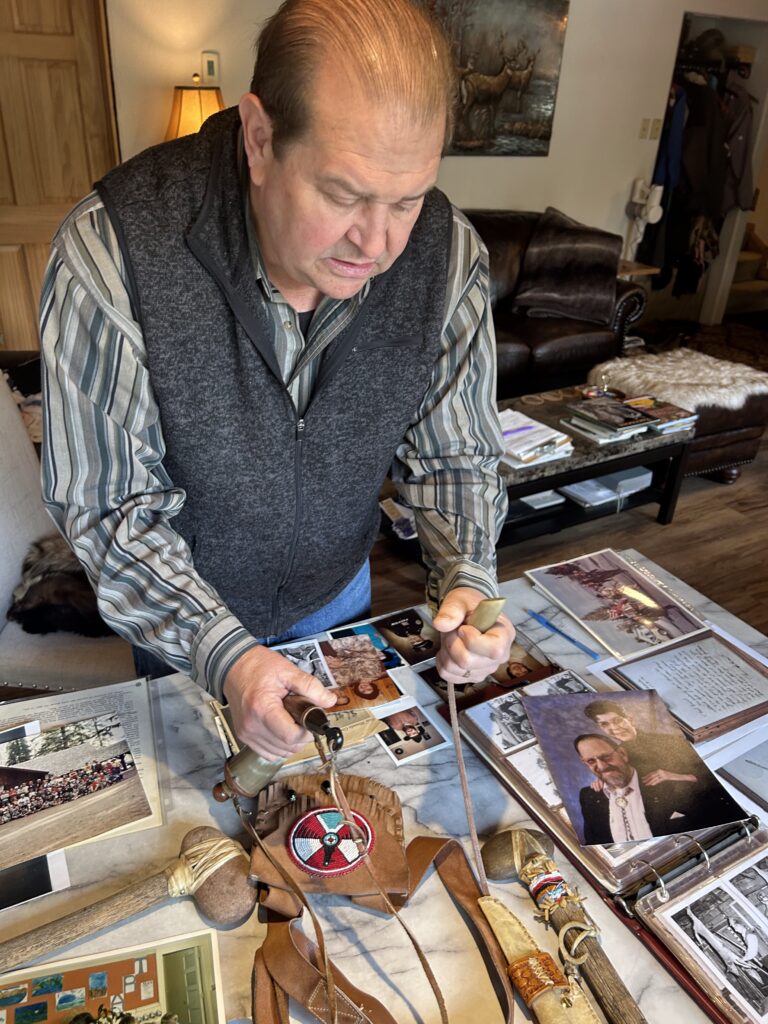
BAYLISS: But Monte did know how to say it. He said it was like living in a glass house. That’s because of the public perception of his dad. On the one hand, there was Darrel the do-gooder. He *did* write that cookbook for the outdoor women’s group. He worked a lot with the Boy Scouts of America, including organizing this annual chili feed to raise money for them. He founded a law enforcement camp up at Seeley Lake for troubled boys. Monte says Darrel felt that if he could help kids earlier, then he wouldn’t have to deal with them later as criminals.
MONTE: So we had a lot of people coming and going. And at times, you wondered about why a person was there.
BAYLISS: And that made Monte feel like he had to be on his best behavior. Because on the flip side, his dad was also this well-known cop who busted people. And he was pretty easy to find living in small neighborhood in a small city.
MONTE JOHNSON: But when your dad says, “Okay, now I’ve got this sawed off shotgun that I acquired from somebody and it’s loaded with 12-gauge, double-up buck, and it’s above the door. If somebody wants to come through the door and is trying to tear it down, just shoot through the door and it’ll get him.” That’s a little bit for a young person to handle. And you’re like, “Well, what if it’s you!”
BAYLISS: Guns, knives, cannons – Darrel was into all of that, and so that became part of Monte’s life, too.
MONTE: He would want to practice shooting his revolver.
BAYLISS: This would be his service revolver, the one he carried for work.
MONTE: And at the time, they had outside firing ranges. But it would be the middle of winter. Right? And so he got a bullet trap, and he set it up at the back door of our house, the house that we had at the time, there on North Second. You could stand at the front door and see straight to the back door, but it went through the front room, the middle room, which is the living room and the kitchen and then the porch out back.
BAYLISS: Darrel would stand with his gun on the front porch and he’d shoot it through the open front door and out the back. Right through his house.
MONTE: And then, of course, he wanted to make sure we didn’t get hit. So we would sit on the couch in the living room off to the side with our ears plugged, and he’d tell us when he was done firing, you know, and the neighbors just got used to it. That’s what he would do.
BAYLISS: And that’s how Monte grew up. But when he turned 18, he found out something huge. It turns out, Darrel was not his biological father. And this will take a minute to explain. It starts with Darrel in the Army, writing letters to a woman named Beverly. He even got her name, “Bev,” tattooed on his arm. When he got discharged in the ‘50s, he headed straight to her, to the tiny town of Ovando, Montana. His plan was to marry Bev and start a family, but Bev’s parents? They had other plans. Beverly had a sister, named Jan. Jan got pregnant, and the father wasn’t part of the picture. Beverly’s family decided Jan needed a husband by the time this baby arrived. Darrel was a young, unmarried guy close to them. Monte says they convinced Darrel that the right thing to do was to leave Beverly, the love of his life, and marry her sister. And, for whatever reasons he had, that’s what he did.
MONTE: I think he felt sorry for her. And he wasn’t necessarily the most debonair, you know, kind of guy. Maybe he felt like he would never find a girl.
BAYLISS: Jan’s baby was Monte. Darrel adopted her little boy and raised him as his own. Monte says he’s glad his dad didn’t tell him about the more complicated story of their family until he was older.
MONTE: So I’ve always told him that I’ve admired him for doing that well, later in life. And, because he always wanted to know, he goes, “Well, you ever thought of me as being your dad?” Given the fact that now we both know that I wasn’t his, I said, “You’ve always been my dad. You know, who else am I going to look to being my dad?”
BAYLISS: Darrel was raised by a man who also wasn’t his biological father – his stepdad. But Darrel’s stepfather never adopted him, and Monte says he didn’t treat Darrel like a son.
MONTE: Yeah, I kind of maybe had a similar life that he did, you know. He might have seen that and the need for what maybe he missed out on.

BAYLISS: Darrel and Jan stayed married and raised Monte together and they found ways to relate to each other as a couple. Darrel was into customizing leather and she’d help him add a bit of art to it. They did a lot of those old west things together. But there were tough years for their marriage, too. There were the ways people knew Darrel, and then there was what was going on at home.
MONTE: My mom kind of went through a little bit of depression at one time. My dad had no clue as to how to deal with it. And I could tell that was the case. He just didn’t know how to handle it. He wanted to handle her like a policeman would handle a domestic issue
BAYLISS: Darrel purchased land near where Jan grew up. After he retired, he wanted Jan to come live with him in a cabin up there. She refused, but he moved up there anyway. He was choosing his own path. Eventually, Monte says Darrel became a tougher guy to connect with as they both grew older.
MONTE: Police can lose their filter a little bit. You know, they can deal with a lot of dark things. And, pretty soon, they can’t keep that separate from their kids and their family and stuff properly. He had a tough time with family, I think more so. They’ll say things that they wouldn’t have said years before, you know, or be willing to tell a story they shouldn’t tell in front of the wrong people.
BAYLISS: Darrel would tell stories and jokes a lot of people might consider offensive.
MONTE: He made people uncomfortable. And you know what? I’m not saying it just from the family side because I do know people that he worked around, and friends that he had, say exactly the same thing and was like, “Is there something wrong with Darrel?” You know? Well, I don’t know. There’s, you know, life was pretty tough on him, you know, in those kind of areas. And you’re asked to do some things that you really don’t want to have to do. And you end up doing it. He would tell a joke that was inappropriate in front of young kids. But he just got to the point where you said, “You know, dad, I can’t be around you with my kids and my wife if you keep doing that.” And I’m not the only one that saw that. And there was other family and family and they were like, okay. So I think he got visited less and less after a while.
BAYLISS: I talked with some people who *did* visit Darrel as he got older and more set in his ways. On a cold but sunny spring morning, I met up at Darrel’s old house in Missoula, on his porch, with his grandson Josh and great grandson Jay. Josh and Jay bring camping chairs to sit on. They are both big men, but not in an intimidating way. They’re warm and patient as I ask questions. Sometimes, his grandson Josh would come by Darrel’s house and see him through the window in his big blue recliner, but Darrel wouldn’t answer the door.
JOSH JOHNSON: That was just his way of being stubborn or isolating himself because he didn’t want to deal with anybody that day. If I was by myself, I could get him to come to the door. I usually get his attention, but even my brothers, he would just flat out ignore them. He just didn’t want anything to do with anybody that day. And then usually come back the next day and check on him if he didn’t want to respond. And then I finally convinced him to give me a house key, then he had no choice.
BAYLISS: Josh walks me around the property, pointing things out and telling me stories about visiting his grandparents here. Some reminders bring up happy memories. Some of them are kind of sad, too.
JOSH JOHNSON: You see the white cross sitting there on the ground? I don’t know if you can see it. If you see the white cross.
(on tape) BAYLISS: Oh, yeah.
JOSH: So that was placed there because when my grandma passed away, that’s when my grandpa found her head first.
BAYLISS: Jan had fallen over the porch railing while having a cigarette. Josh says she was on oxygen at the time and she landed in her rose bushes.
JOSH: There used to be these big three-tiered planters because she grew all kinds of different flowers. And he had them all torn down because he couldn’t stand looking at them anymore.
BAYLISS: The more stories I heard about Darrel and his family, the more I appreciated their willingness to be honest – about how people are not just one way. Both Monte and Josh tell me real stories about this flawed person, but I would say they also give Darrel a lot of grace. They knew his job was tough on him. And his life growing up was hard, too. Josh actually spent a lot of time at his grandpa’s house and Darrel was like a father to him. Josh’s dad wasn’t in his life, either – it’s kind of an echo of what both Darrel and Monte went through. This is a whole family where generations of men did not have their biological dads in their lives, raising them. Josh thought about that when it came to Darrel and to his own life.
JOSH JOHNSON: I think he took what he dealt with as a kid and never wanted to put that on anybody else ever again. And I’m the same way. I have a stepson. I raised him since he was three years old. I treat him just like I do my blood son and my daughter.
BAYLISS: The great grandson, Jay, hadn’t been back to the house since the family divided up Darrel’s things. Jay got his great-grandpa’s old rocks – and his cassette tapes, which Jay was really into. That was something he and Darrel had in common.
JAY JOHNSON: It felt good to have somebody who had a shared interest that wasn’t necessarily around my age. It was this deeper feeling of acceptance and importance.
BAYLISS: Jay knew yet another side of Darrel, the Darrel who lived alone into his nineties and looked forward to seeing this young guy in his life who’d come by and ask to listen to his old tapes or see his rock collection.
JAY: And I always enjoyed whenever he would talk about any old music that he knew and any old rocks that he had found. This is an old cassette carrier that he had. This whole row is his collection. And then Cash was always one of his favorites, and it’s always been one of mine.
[Johnny Cash tape playing]: An old cowboy was riding out one dark and windy day…
JAY JOHNSON: I was too scared to go see him in his last couple of days, I just didn’t want to see him like that. Just to see — just to look at a man that I’ve always looked up to my entire life. And having to look down to him in that state that he was in. It would have done more, more bad than good. It helped preserve that image that I had of him. Just the strong, tall image that I had of him.
[Johnny Cash song comes back and fades down.]
BAYLISS: Back at Monte’s kitchen table, he said something I keep thinking about.
MONTE: I’m going to say my dad was simple, okay? And so when you do complex things with a simple person, they sometimes won’t be successful in dealing with it, but they’re going to have to do it in their own way.
BAYLISS: I don’t know all the dynamics in this family or in Darrel’s life. But I keep thinking of this idea – that Monte would describe his dad as simple when everything I learned about Darrel opened up a new – and I would say, pretty complex – side of him. He *was* all those things he wrote about himself in his obit. And the people in his life filled in the rest – how *they* knew him. I got to learn a lot about this one person. I think that’s what a lot of people go through after someone dies. The ones who are still alive have to reconcile all the parts – all their own memories of someone and what others remember, too. I think maybe Monte says it best – so I’ll let him.
MONTE: He was a person that wanted to always do what was right. But he was a human. He was imperfect.