

By Charles Bolte
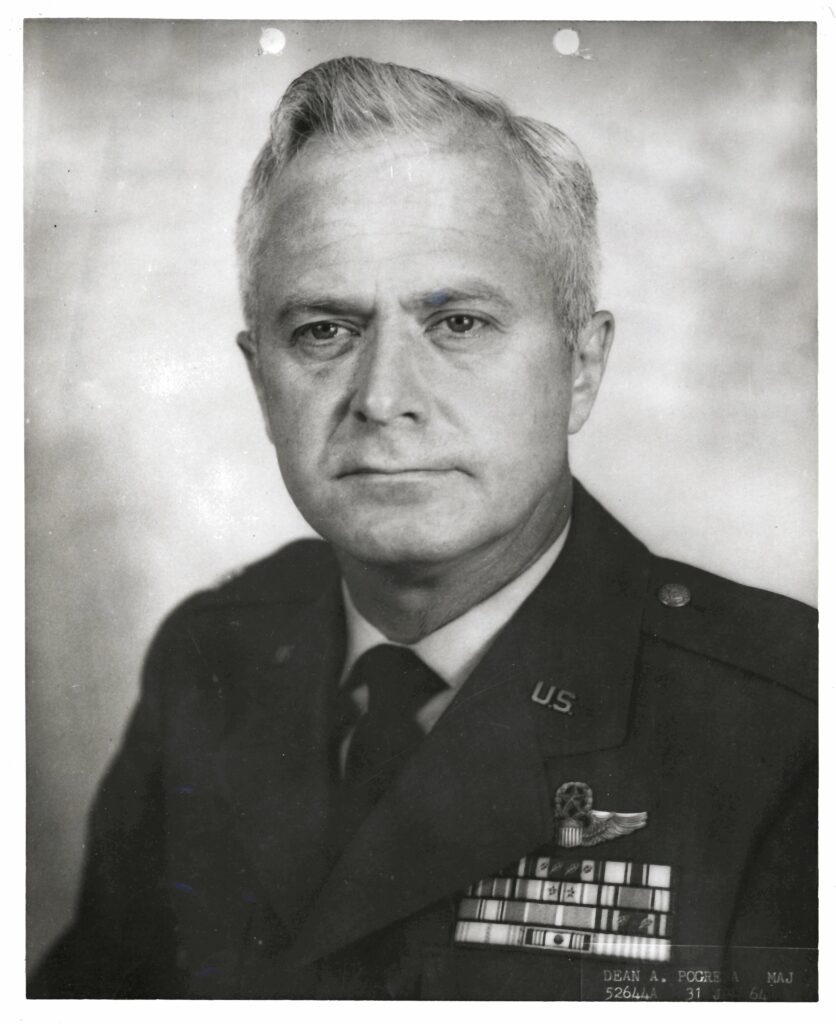
Charlie: The first time I met Maxine Pogreba was at a senior center in Bozeman, Montana. It was 2014. I was in my 20s and she was in her 80s. She had this energy about her. She was upbeat and friendly. And she was strong, too. She might’ve looked small, but when I shook hands with her, her grip surprised me. I was there to take her picture for a student project. We got to talking about her life while she posed for the photos. She told me she grew up on a ranch a couple of towns over, fell in love with a local boy, got married and raised a family. But then, she told me a story that stunned me. Her husband, Dean, was a fighter pilot in the U.S. Air Force. He was a seasoned vet who flew in three wars. One day while flying a combat mission over Vietnam in 1965, he dropped his payload over a bridge, pulled up into the clouds … and vanished.
Maxine’s story stuck with me – because of the vanishing part for sure. But also because I’m a vet – I was in the Army and served in Afghanistan and Iraq. And while I know that the war in Vietnam was another era, I just can’t wrap my head around the idea that one of my buddies could disappear in a combat zone. With all the training we did and the ethos banged into us – “never leave a fallen comrade” — it didn’t seem possible. So five years after I met Maxine, I sat down with her and her kids to talk about what happened to their family, what they went through when Dean Pogreba disappeared and how they spent years trying to figure out what happened to him – all the while hoping he’d turn up.
Charlie: Okay. I’ve pressed record. So, um, do I have permission to record everybody that’s here at the table? That would be Maxine, Beverly and Karin?
Beverly: You do. My permission.
Charlie: And do I have permission to record you Maxine?
Charlie: Good. Thank you.
Charlie: Maxine’s son, Larry, isn’t with us at her kitchen table in Boulder, Colorado. But we’ll hear from him later. The Pogrebas are a fun, tight-knit bunch. You’ll hear Karin and Beverly laughing in the background as we go way back to the beginning. To the town of Willow Creek in rural southwest Montana where Maxine grew up during the Roaring 20s and the Great Depression.
Maxine Pogreba: It was a wonderful little town. Willow Creek had a lot of things going for it. And the railroad hired a lot of people through there back then. And there was, um, different, little goldmines. And, and some good ranches, really good ranches. And they built a beautiful school there and it had all 12 grades.
Charlie: There was a flour mill, a meat market, and a merchant who sold everything from food to clothing. But one thing was missing.
Maxine: No bar.
Charlie: No bar?
Maxine: No, bar. No. Not for a long time. Maybe after World War II.
Charlie: They did have a country doctor. And he delivered Maxine and her eight siblings, the Albro kids. Their mom and dad–Binah and Willis–raised them all on the family ranch.
Maxine: It was a working ranch and it was 650 acres and mostly, uh, grain and hay. And a garden. We had about 200 head of cattle, 20 milk cows. That’s work. And a hired man. So we, we were workers.
Charlie: Just north of Willow Creek is another ag town called Three Forks, and that’s where Dean Pogreba grew up. Maxine remembers a time she saw him in a parade there. He and his two brothers rolled down the street with a tricycle they made to look like an airplane with some plywood. Maxine says she was six at the time and Dean was eight.
Maxine: It’s so funny that I would remember those little boys because they, they all had messed up hair. You couldn’t keep their hair down. And my mom would mention, “oh, my, those boys don’t look very tidy do they.” And so, but they were darling, they were so cute. And I liked that lit- that little one, that little eight year old. I thought he was okay.
Charlie: Fast forward a few years and Maxine wasn’t catching glimpses of Dean at parades. She was attending his high school basketball games and they were going steady.

Maxine: And he came out to the ranch one day to meet my dad and mom. And he was on a motorcycle. Oh dear. My dad says, “you know, son, I don’t know about that motorcycle. Next thing you’ll be flying a damn airplane.”
Charlie: Dad hit it dead on. Dean saved up money and took lessons with a local pilot. Of course, Dean took Maxine up in the air, too. Her first time flying was with him in a little airplane.
Charlie: How did you feel going up in an airplane for the first time?
Maxine: Oh, I thought it was wonderful. My dad thought it was terrible. Yeah.
Charlie: When you were falling in love with Dean, when you were younger, what was it that made you fall in love with him?
Maxine: Well, I think it was his steadiness, you know, I knew that, um, uh, he was what you saw was what you got. He had a way of kind of keeping things calm. And in order.
Charlie: Flying soon led Dean to the military and away from Three Forks. He was two years older than Maxine, but they kept up their relationship while she was still in high school and he was in Arizona for cadet training.
Maxine: We wrote a lot of letters, which um, kinda gave me a better idea of who this guy was, because he could say things in a letter that he couldn’t say in person. Yeah. He was a little bit, it wasn’t shyness.
Charlie: He was kind of reserved.
Maxine: He was strict, but he yet, he was kind, you know, I can’t imagine him being a cranky old guy. Like some of these guys. I just can’t imagine that.
Charlie: Dean graduated from the U.S. Army’s aviation school in Arizona in 1944. That’s when things went official between Maxine and Dean. They got hitched at a little chapel on the airbase and are lucky to have a photo to show for it.
Maxine: because neither one of us had a camera. So he was a brand new second lieutenant. And I had just taken a couple of weeks from my job to go down for his graduation. And we decided to get married.
Charlie: Life got busy for the Pogrebas. Dean left not long after the wedding to fly a cargo plane in World War II. He’d also fly fighter jets in the Korean War and, of course, in Vietnam. Between the wars, he and Maxine raised three children. They were stationed all over, including a stint in Europe. By 1965, the Pogrebas were back in the U.S. – at a base in Kansas. Larry, the oldest, was in college. Karin was in high school and Beverly was in grade school. Dean and Maxine were mapping out their retirement when Vietnam upended everything.
On the morning of October 5th,1965, Dean and his squadron were on a mission to bomb a bridge 45 miles northeast of Hanoi. Dean dropped his payload over the target. He pulled up into the clouds and radioed that he was heading east to a rally point over the Gulf of Tonkin. He never arrived. 12 hours separate Vietnam and Kansas. So when it was getting late over there, it was morning in Wichita. That’s when the phone rang.
Maxine: A friend of ours called from Tokyo. I don’t know why he wanted to be the first to tell me, but he just wanted to extend his con- condolence, you know.
Charlie: Karin and Beverly were getting ready to go off to school. Karin was 14 at the time.
Karin: I heard the phone call and, and then I heard, heard my mom, you know, she kind of cried out and, and then, um, yeah, I think I just went into shock.
Maxine: About an hour later that big, blue Air Force limousine comes pulling up to your house and the base commander and his wife get out and the chaplain. And they come to your house and tell you the bad news.
Karin: I can barely remember the people coming to the door.
Maxine: I can’t remember what they said but all they said was sure sorry. But I don’t remember they said very much.
Charlie: In the days after that knock on the door, Dean’s family still had reason to hope. He was shot down over North Vietnam on another mission two months before and rescued after a couple of hours. Beverly was 10 when her dad disappeared.
Beverly: I really thought, oh, he was shot down before, so he’ll probably, he’s probably hiding or he’ll figure out how to get home.
Charlie: A quick rescue didn’t happen this time. And to make things more complicated, there were no leads. None of the other pilots saw Dean go down. They did what they could to search from the air, but nothing turned up. All the family could do was wait and hope. Days stretched into weeks … then months. The Department of Defense stayed in touch.
Karin: They’d bring us pictures about every six months or so, maybe to look at and see if we could identify unidentified, uh, prisoners of war. And they were all those grainy sort of pictures, you know, and emaciated-looking men. So it was hard to tell, like it was, you know, we, we did think we found him once, but he ended up being a Navy pilot.
Charlie: How did you cope in that first year?
Karin: Well, I think I buried it more than anything. Because, you know, I had to go to school and, but, um, my mom, you know, my mom was suffering for at least a year. She was suffering pretty, um, you know, noticeably, yeah, yeah.
Charlie: You saw how it impacted her physically?
Karin: I did. Yeah. Yeah. And especially I see it now, when I look at pictures too, you can see it.
Charlie: By 1967, Maxine was ready for a change of scenery.
Maxine: I was getting weary.
Charlie: She’d visited Boulder, Colorado, before.
Maxine: And I thought, you know, I gotta start over. I gotta have something new. So we just packed up and left.
Karin: We kind of, not that we moved on, but we were young and we were looking forward and busy with things. And so we sort of, um, you know, our lives kind of became full again, but you know, that never left. It was just sort of buried. I think. More than anything.
Charlie: Maxine eventually remarried. The kids grew up, left home, and started their own lives and families. But they never stopped trying to find out what happened to Dean. Then in 1977, the Pogrebas received a grim letter from the U.S. Air Force. Dean’s case had been reviewed and, since there was no concrete evidence that he was still alive…
Maxine: It was with a flick of a pen and they declared him dead.
Charlie: How did you feel about that?
Maxine: How did I feel about that? What can you do?
Charlie: When someone dies, there’s usually a funeral. And a body to grieve over to help people process what’s happened. But Maxine and her kids didn’t get that. Even if the U.S. government told them he died, it was still a kind of question. What if he was still alive and over there somehow? That sliver of hope hung there for decades. The Pogrebas looked into a lot of theories about Dean. Even the more extreme ones. There was the idea that maybe he was shot down in China. Or the story that someone saw him in Vietnam years later. But nothing panned out – only more dead ends. When Dean’s military ID card turned up in 1992 in a Hanoi museum, it was another window of hope. Notes accompanying it said Dean died when his plane crashed and that his body was left at the crash site. But the card only brought up more questions for Maxine.
Maxine: Well, the one thing I think we noticed was it wasn’t damaged, you know..
Charlie: So, it made you wonder…
Maxine: It made you wonder if he landed, jumped out again.
Charlie: She never found out. Her kids never found out. Maxine lived the rest of her life in Boulder, where the newspaper there – the Daily Camera – ran a feature about her in 2024. The headline on it was “Ready to Go.” After living most of her years wondering what happened to her first husband, Maxine Pogreba chose an ending that doesn’t have any lingering questions. The article described the teal dress she wore and her plan to use Colorado’s law allowing medical aid in dying.
Karin: She was under palliative care
Charlie: That’s her daughter, Karin.
Karin: And, um, she basically decided to end her life. She decided that, you know, she couldn’t hear very well anymore and she couldn’t see, and you know, her world was just getting so small and um, she just wanted to make that decision herself.
Larry: Oh I mean At first, you know, you try to talk her out of it. Because she was still mentally real together. If I was being slowly shut out of the world. With, you know, uh, eyesight and hearing, I, maybe I’d wanna do the same thing.
Charlie: Maxine was 99. Beverly says that when her mom was in her 60s, she was involved with the Hemlock Society in Boulder. That’s the group fighting since the 1980s for the right to choose a physician assisted suicide. So it wasn’t a big surprise when Maxine started talking about that for herself.
Beverly: Every once in a while she’d say something like, yeah, if I get too sick, I’ll just wanna turn the lights off. You know, she’d say it like that.
Charlie: About a dozen of Maxine’s closest family members gathered in her senior living apartment on the day she died.
Larry: Everybody was, uh, you know, I mean, just kind of quiet and red-eyed and, uh, as soon as you realize you’re not gonna talk her out of it, all you could do is just support that decision.
Charlie: Then, Maxine went to her bedroom and laid down. She drank a cocktail of medication and Karin read an Irish poem. Then Maxine drifted off to sleep for the last time.
Beverly: We were all ready. We were all, all told what would happen and, nothing unexpected at all really. Glad it was peaceful.
Larry: The whole thing is just, uh, it’s so civil. I mean, compared to, you know, if somebody tips over at three in the morning and they die all by themselves. It’s so much nicer when the whole family is there.
Karin: I’ve made peace with it for sure, but. I don’t think I’ve changed my idea of the decision, really.I still think that I, I would prefer, I would’ve preferred if she hadn’t done that, but, you know, she was just, she was so afraid that she might end up unable to make the decision and then being kept alive or something like that. You know?
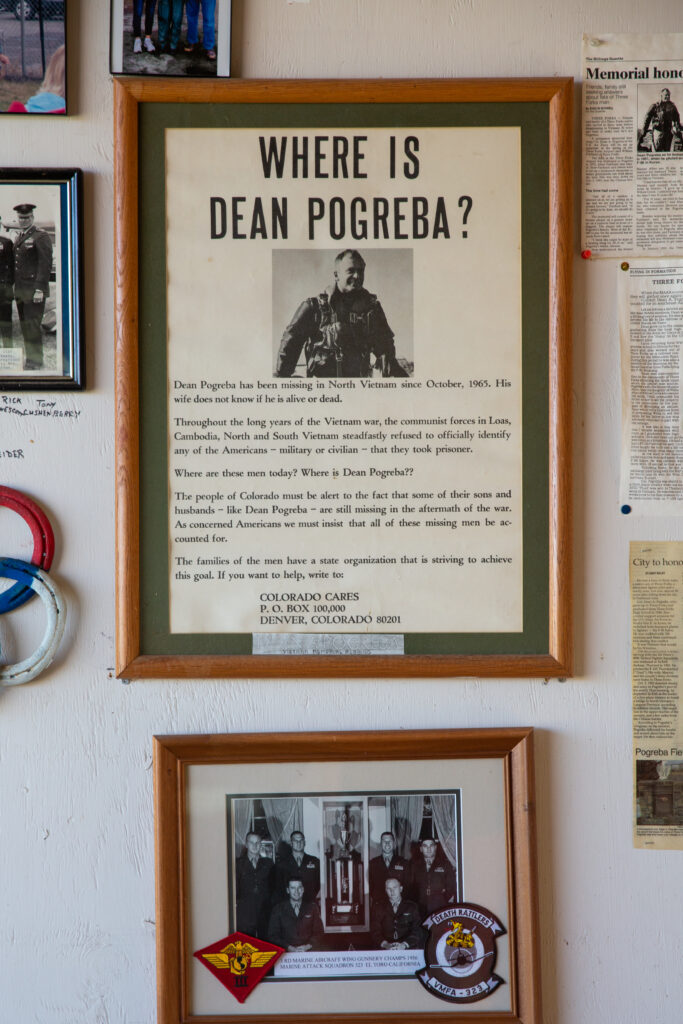
Charlie: Maxine is buried at the Willow Creek Cemetery near the ranch where she grew up. About six miles up the road is the Three Forks Airport, which was renamed Pogreba Field in 1971 to honor Dean. There’s a big bronze plaque set in a stone monument that tells a part of this story. And in a small hangar not far away is a wall of photos and newspaper articles that tell a bit more of it. The centerpiece is a framed picture of Dean dressed in a flight suit. In bold letters above the photo it gets at the part of his story no one knows. It asks the question that’s unanswered all these years later: “Where is Dean Pogreba?”