

By Jacob Baynham
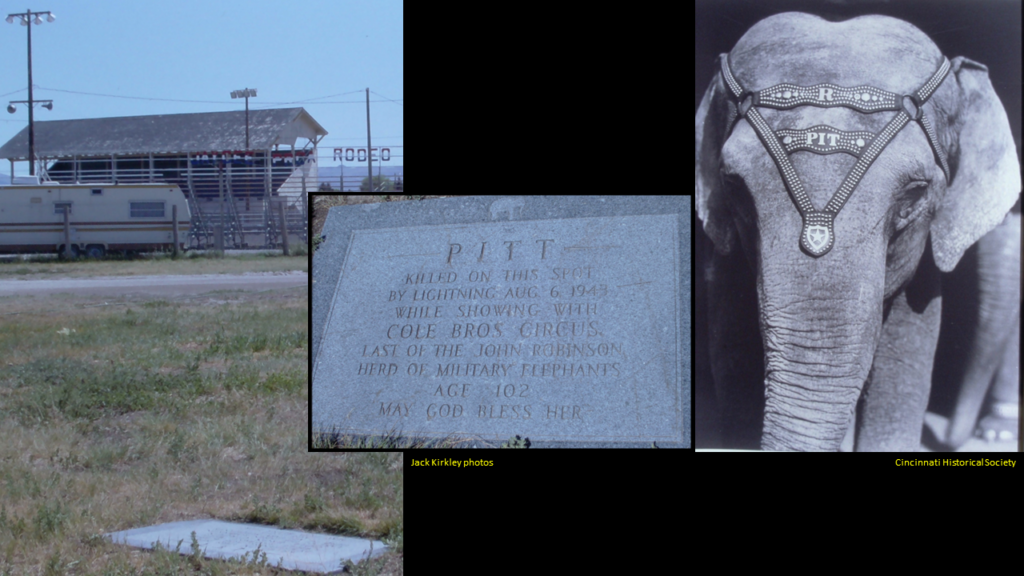
JACOB BAYNHAM: Dillon, Montana, is your typical Western railroad town. Two stoplights, brick buildings that yield to ranchland at the city limits. It’s home to 4,000 people, the University of Montana – Western and a pretty good Mexican restaurant. It’s what’s underneath Dillon that’s surprising. You can find it on Google Maps, in the southwest corner of town, marked with this inscription: “Old Pitt, Elephant Killed by Lightning.” Actually, it’s been misspelled on Google for years. It says “lighting. Elephant killed by lighting.” Which is kind of endearing. But you get the idea. There’s an elephant. It was struck by lightning. And it’s buried in Dillon.
VOXPOP: You knew there was an elephant buried out there. We all knew that. Even as kids.
Well, I wonder how many elephants were hit by lightning in the United States, for heaven’s sake.
It is an odd thing that an elephant is buried in Dillon, Montana.
It is such epic local, and it’s not lore. I mean, it’s not legend, it’s just, it’s part of our history.
JACOB BAYNHAM: The story of Dillon’s elephant goes back to a hot summer day in the middle of World War II, when a 7-year-old boy named Keith Andersen was headed to the circus in a shiny new pair of shoes.
KEITH ANDERSEN: I didn’t wanna wear ’em but I did. And my mother made me wear ’em because I was going with the neighbor woman.
JACOB BAYNHAM: That’s Keith. He’s 89 now and lives with his wife, Verla, in a single-story house in a new development in town. Keith grew up in the hills outside Dillon, in a log cabin with no water or electricity. His parents raised sheep. The family was poor, and the work was hard. So the chance for a diversion on a summer afternoon was special. When Keith was 7, the biggest diversion of all came to town.
KEITH ANDERSEN: I was lucky to get to go to the circus. I suppose it cost a quarter or something.
JACOB BAYNHAM: The Cole Brothers Circus pulled into town that year with a brand-new tent, the color of a new pair of Levis, large enough to seat 2,000 people. The elephants helped set it up on a day that started out, weather-wise, like most others. Then the storm hit.
KEITH ANDERSEN: I don’t know where it came from. And it was very noisy in the tent. I think the tent was even dripping. A little bit of rain, it just poured rain, just, it was just a sea of mud out there when we left.
JACOB BAYNHAM: The elephants huddled outside, waiting to perform. But before they made it into the tent, lightning struck. Three elephants and their trainers fell. One of them — a 9,000-pound Asian elephant named Pit — never got up.
KEITH ANDERSEN: The show went on, you know, like they say. Uh, but we got shorted on the elephant part of it.
JACOB BAYNHAM: A circus hand threw a tarp over her, but there was no avoiding the wet hulk of that animal, larger than any creature on this landscape. Her 30-pound heart just stopped – like you imagine it might when seized up by 300 million volts of electricity. Keith remembers walking past the body as he dirtied his new shoes in the mud.
KEITH ANDERSEN: As we walked out, we saw the dead elephant. And I’m sure if there’d had been another exit, they would’ve rerouted us.
JACOB BAYNHAM: Elephants weigh several tons, so the general rule is that you bury them where they fall. Pit lay there all night and into the next day. People drove out to take pictures, posing with rifles as if they’d bagged a trophy on safari. In one photograph, a woman in a prim skirt suit stands on Pit’s trunk wielding a gun like a Chicago gangster. Eventually, a man arrived with a bulldozer and dug a trench eight feet deep. According to some reports, a few people shot rifle rounds into Pit’s side so she wouldn’t bloat with gas. Kids rolled up on bicycles to watch the four-ton animal drop with a muffled thud into the hole.
KEITH ANDERSEN: Not every day you get to see a dead elephant, you know?
JACOB BAYNHAM: The dozer covered her up with dirt, and that’s where Dillon’s elephant lay, for half a century, until a professor from Ohio came to town and hatched a plan to dig her up.
JACK KIRKLEY: I grew up in the Midwest. I was always a suburb kid from, you know, the corn and soybean country,
JACOB BAYNHAM: Jack Kirkley is 72 and a retired biology professor at UM-Western. And at this point, he knows more than anyone else does when it comes to Pit. He’s spent half of his life tracking down her story. As a boy, Jack hopscotched around Illinois, Indiana and Ohio. The West loomed large for kids like Jack, growing up in the middle of the country and hemmed in by agriculture and industry. Jack’s dad wanted him to be a dentist. He wanted to study birds.
Jack finally moved out this way to do his graduate work in ornithology at Utah State. When he finished in 1985, he landed a job at UM-Western in Dillon. He’d never heard of Dillon. But when he toured campus, a bald eagle flew overhead. It was like a benediction.
JACK KIRKLEY: I thought, wow, this is, this is raptor heaven. I can tell that already. I, I’m a,I’m, I’m, I’m home.
JACOB BAYNHAM: Jack can’t remember when he first learned about the elephant. People here seem to absorb the story by osmosis. But eventually Jack wandered up to the fairgrounds to find the headstone. Back then you had to hunt for it in the grass. During the rodeo, people parked horse trailers on top of it. Finally, Jack found the slab of granite etched with an elephant and a short epitaph:

JACK KIRKLEY: Pit killed on this spot by lightning. August 6th, 1943, while showing with the Cole Brothers Circus. Last of the John Robinson herd of military elephants, age 102. May God bless her.
JACOB BAYNHAM: Jack didn’t think much more about it until a few years later, when he had some questions about preserving a mastodon bone a colleague of his found in Wyoming. That kind of task is a welcome diversion for a naturalist like Jack. He called a curator at the Museum of the Rockies in Bozeman for advice.
JACK KIRKLEY: And just as an aside, I said, by the way, did you know we have an elephant grave in this town? He said, really? He said, you know, that would. You put an elephant there, every bone would be perfectly in anatomical position, and you could dig that up and, and, and recreate a whole elephant skeleton.
JACOB BAYNHAM: The collection and preservation of biological specimens is as old as science. In the 1600s, European museums filled “curiosity cabinets” and “wonder rooms” with assortments of exotic animals from far-flung places. Even in the Midwest suburbs, Jack spent his childhood collecting butterflies and gluing together animal bones.
JACK KIRKLEY: Having specimens is, is, is second nature in biology. And I, I, I always took that as a given that. That was okay.
JACOB BAYNHAM: An elephant would be his biggest specimen yet. He wasn’t the first to have this idea, though. When Jumbo, the famous circus elephant, was killed by a train in Canada in 1885, P.T. Barnum included his skeleton in his menagerie. And it wasn’t just spectacle. Stories are written in an animal’s bones. When scientists later examined Jumbo’s skeleton, they learned he had impacted molars due to a poor diet. His life in captivity affected his joints, too, causing them to prematurely age. The idea of digging up Pit took root in Jack’s mind. It was 1991, and Jack had lived in Dillon for five years. This could be his contribution to the community. He could get the Boy Scouts involved. He drafted a letter to the local museum, fleshing out his plan to unearth Pit and display her skeleton.
JACK KIRKLEY (reading letter): Dear museum board members, I would like to propose a project of historical significance for your consideration. Last year, I was discussing the preservation of large bones with one of the curators at the Museum of the Rockies and the topic of Pit, the elephant buried on our county fairgrounds….(trails off)
JACOB BAYNHAM: But all the hope Jack had in that project fell flat six weeks later, when he received a curt rebuke in cursive from Theo Bay, a sturdy, discerning, rosy-cheeked woman with coke-bottle glasses that magnified her eyes. She was the former superintendent of schools for Beaverhead County, and she was, in effect, calling Jack into the principal’s office.
HILLY MCGAHAN (reading letter): Sir: This is a letter of protest and to warn you. If you so much as scratch the dirt on Pit’s resting place, less than one week after your bones are laid to rest, I will have them moved to a dusty bin in the museum. You could use your time to research to find out how many have a grave for a circus elephant killed by lightning as the circus band played “Bring in the Clowns” to show to visitors.
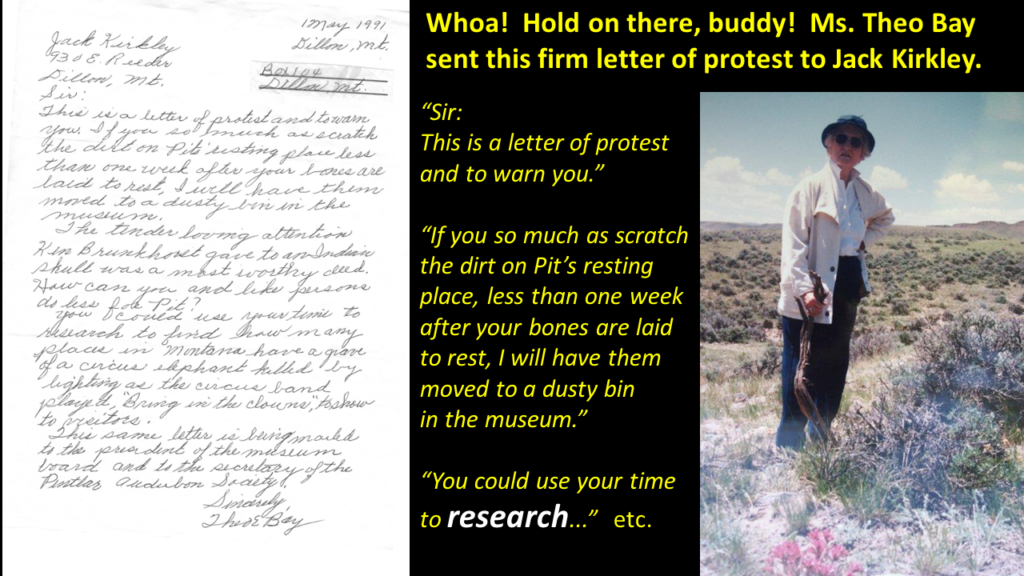
JACOB BAYNHAM: And here’s where I let you know that I am not a disinterested party to this fight. I have a connection to Theo. She was my wife’s great aunt. We actually named our first son after her. Aunt Theo died in 2008. And that was my wife, Hilly, reading Theo’s letter. Hilly remembers visiting Dillon around the time of this elephant drama. The story made such an impression on her, that when she got home, she wrote about it on her kindergarten computer. She’s gonna read it as she wrote it, but dear listener, I wish you could also see the spelling!
HILLY MCGAHAN (reading journal): WE WENT TOO DILON … WE WER GUNU GO SEE A ELEFINTS GRAV THAT DID OF LINTING IT STRAK AND THIS MAN WANTID TOO DIG HIS BONS UP TO PUT IN THE MUZUM AND ANTTHEO SED NO OR ILL DIG YOU UP WHEN YOU DI
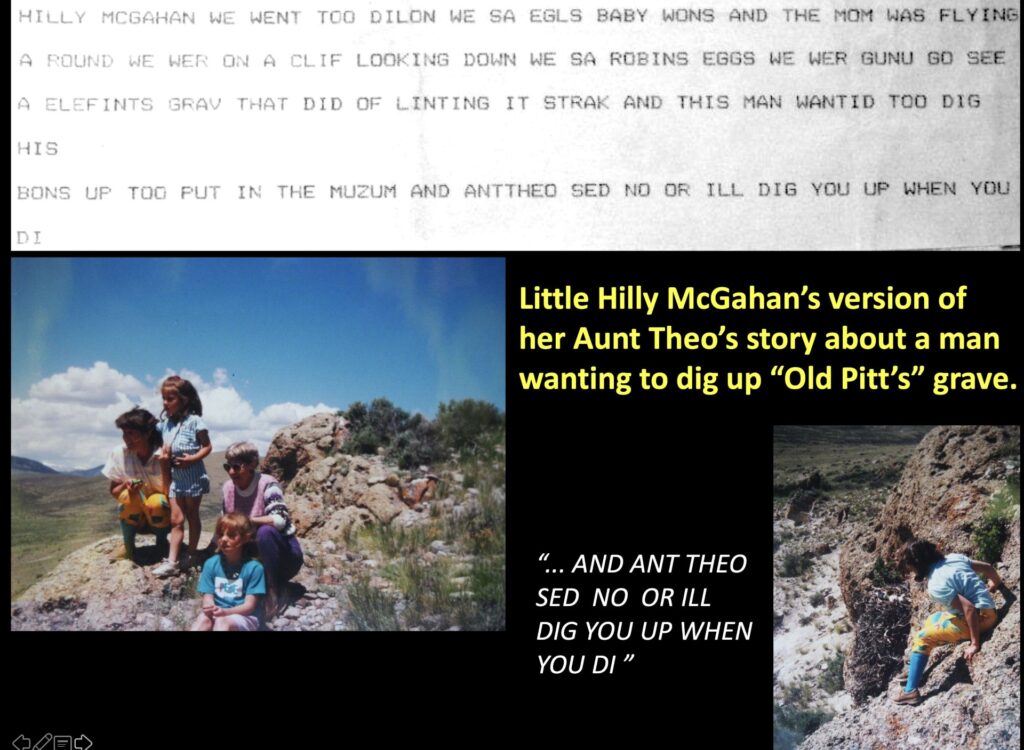
JACOB BAYNHAM: Aunt Theo had moved to Dillon from North Dakota when she was about 30, roughly the same age as Jack was when he moved here. It’s not clear if she was at the circus when Pit died, but Theo was a woman with scruples. Table manners were sacrosanct. Disturbing the dead, animal or otherwise, was sacrilege. But back to this fight about the bones. Upon receiving this kind of aggressive letter from Theo threatening to bin his dead body, Jack Kirkley fired off a few more letters of his own. He wrote to the wife of the late Cole Brothers Circus owner, who thought it was fine to dig up Pit. Eventually, Jack wrote back to Theo, inquiring about her position. Were her objections religious? Ethical? Was displaying an elephant skeleton different than mounting an elk head? If so, why? He never got a response. And even though Aunt Theo is family, I think I understand Jack’s predicament. Like Jack, I wasn’t born in Montana, and it seems like, as an outsider, he’d crossed an invisible line. No one was going to explain it to him. But he couldn’t ignore it.
JACK KIRKLEY: I didn’t realize how sacred this site was. To some people, this is like saying you’re gonna dig up somebody’s grandma. I was the new guy. And, uh, so instead I started just trying to figure out what was true and what wasn’t.
JACOB BAYNHAM: Jack’s retired now. He’s thin and a little stooped, with the white goatee of a Spanish explorer. He still lives in Dillon with his wife in a house full of elk antlers and exotic souvenirs: boomerangs, machetes, colorful art from Mexico. His pets include a rescued cat and three dogs he found in a cardboard box at the Rocker exit off I-90. He doesn’t own a cell phone, and in his spare time he teaches second graders about owls.
JACK KIRKLEY: Animals have always been intriguing to me. … my favorite thing is putting up a blind next to a Goshawk nest and sitting there for hours and watching what happens in the life of a bird,
JACOB BAYNHAM: I actually met Jack 10 years ago and it’s kind of a funny story. This was on a float trip down the Yellowstone River with a family friend who studies peregrine falcons. We were all going to observe nesting sites and count falcon chicks. My wife, Hilly, was there, and our son Theo was a year old. We met Jack and his family at a campground the night before we started floating.
JACK KIRKLEY: You introduced us to your little son, Theo. And, and, uh, I think your wife mentioned, well, he’s, he’s named after, um, my auntie Theo, who, who used to live in Dillon and all of a sudden, a light bulb went off in my head and I went, um, would that be a woman named Theo Bay? She said, yes. That’s my Auntie Theo. I said, well, did she happen to mention that there’s a, a, a a mean old professor in Dillon that wanted to dig up an elephant? And she said, oh, yes, I heard that story from Auntie Theo.
JACOB BAYNHAM: Well, Jack didn’t have any ill will toward us and we didn’t have any toward him either. It was a fabulous trip. Afterward, I followed up with Jack. I thought I might write about the elephant for a magazine story – that’s what I do. I’m a writer and he definitely had a story. I didn’t know at the time, but this interest of mine prompted Jack to launch himself anew into the story of Pit. He had a slideshow about it gathering dust in a carousel in his office and then after my call, he digitized it. I didn’t end up writing that story then. But I didn’t stop thinking about it, either. That’s how, 10 years after I first met Jack, I found myself in his living room on a weekday afternoon as he pulled the shades on his windows, fired up his projector and showed me his slideshow on Pit’s life. Jack calls it a good cure for insomnia, but the slides contain the single most comprehensive story of Dillon’s elephant. His research began with her epitaph.
JACK KIRKLEY: It said the Cole Brothers Circus was there and it said it was the John Robinson military elephants, which didn’t really ring any bells and at 102 years old really elephants live that long.
JACOB BAYNHAM: Jack Kirkley is not prone to passing interests. When he gets curious about something – whether that’s goshawks, mastodon bones, or, in this case a circus elephant – he goes deep. Real deep. His curiosity for this elephant grew into an obsession. He drove across the state to inspect old newspaper clippings in historical archives. He spent hours going down rabbit holes on the internet. The more Jack dug, the more he revealed about the elephant under the headstone. He learned the John Robinson Circus was based in Cincinnati. Robinson was this Midwestern guy who got out and traveled wherever he could with these huge animals. In fact, John Robinson brought the very first elephants to Montana in 1883 – that was when it was still a territory and not yet a state. They even came to Dillon when the town was just three years old. Jack found out Pit’s origin story. Pit was born around 1893, most likely in India. At some point, she was captured and shipped to a zoo in Germany. That’s where the John Robinson Circus bought four baby elephants in 1900. They crossed the Atlantic in a boat. The littlest was named Petite – Pit for short. PITT on her headstone.
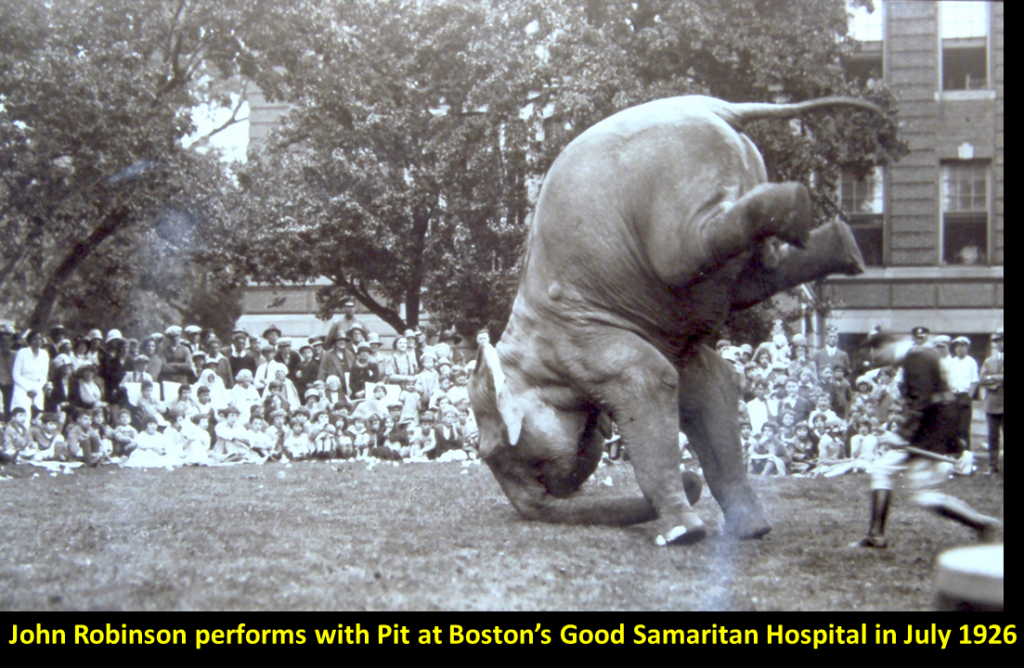
JACK KIRKLEY: The name Pit is actually spelled with a single T when you see it on the name plate of the closeups of the elephant the John Robinson exhibits….
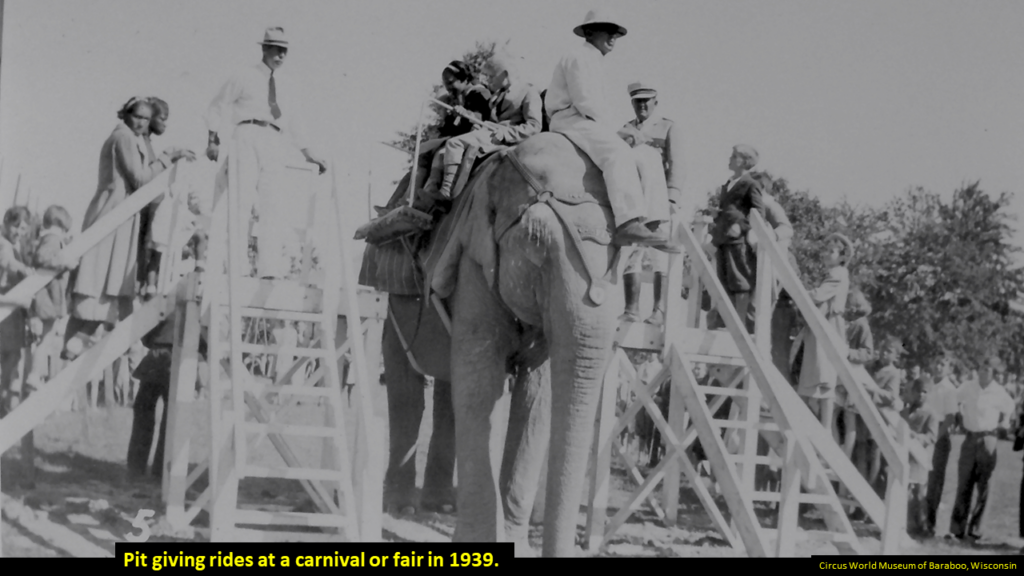
JACOB BAYNHAM: Pit crossed the country with this circus. In a typical season she’d visit 21 states and travel 11,000 miles by train. Circuses were a big deal in these days before television and even radio. People dressed up in their finest to see acrobats and animals they’d only read about in books. When the John Robinson Circus ended in 1911, Robinson kept five elephants, including Pit. They performed in vaudeville theaters in New York City, and starred in silent films in L.A. They visited Cuba, led political parades, and cheered up children at orphanages. During World War I, they acted out patriotic skits as the John Robinson’s Military elephants. A few years ago, Jack visited the archive at the Robinson estate, outside Cincinnati. He found photos of the elephants. They just look like elephants to me, but Jack’s learned to tell them apart, mostly by their ears. Or, in the case of Pit, with this odd growth she had.
JACK KIRKLEY: : That’s Pit, you can see that little tumor on her side just behind her left shoulder. And she’s got an ear that’s kinda like a human ear on the front, top edge there.
JACOB BAYNHAM: Pit was the last living Robinson elephant. She was given to the Cole Brothers Circus in Kentucky. In 1943, when she came to Montana for the last time in her life, Pit had only been with her new owners for a few months. She arrived in Dillon on a train that was a mile long. It was filled with a thousand people and hundreds of animals. Before the circus began, little kids came by to feed peanuts to Pit and the other elephants. One of them was Roy Cornell, who was just three and a half when he went to the circus that day. He remembers sitting in the first section of bleachers, not far from the tent door. When the storm hit, rain poured in through the holes of the canvas around the tent poles.
ROY CORNELL: There was these big incandescent light bulbs hanging on these poles.
JACOB BAYNHAM: Roy and I talked on the phone when he was holed up with a broken leg after a fall.
ROY CORNELL: Well, the water would come splashing through those holes in the tent with that heavy rainstorm happening. And the water would trickle down on those hot incandescent light bulbs,great big light bulbs, and they’d pop and shatter and the glass would shower down over the top of us.
JACOB BAYNHAM: Roy remembers watching the elephants lining up outside the white door of the tent. And then, somewhere in the middle of the tightrope act, the lightning struck.
ROY CORNELL: My mother had been teaching me to, to not be afraid of lightning and thunder. And, and I was sitting next to her and she jumped six inches when that, when that thunder went off. Then, then she had to act like it wasn’t anything to be afraid of.
JACOB BAYNHAM: Roy didn’t know what had happened outside. No one did. Instead, he recalls some handlers briefly waltzing a couple nervous elephants through the tent and back out again. As for Pit, she stayed where she fell, on her left side, her tumor pressed against the wet earth. In all his research, Jack has only found one individual portrait of a Robinson elephant, and it’s of Pit. Her name is printed on the leather harness across her forehead, P—I—T. Her eyes are big and watery. Jack keeps that photograph on his fridge. From this distance, it’s hard to know Pit’s nature and how she was treated. But the photographs tell Jack she was gentle. He thinks she was both trusted and loved.
JACK KIRKLEY: She was a good elephant. If you have to be a captive animal, this probably wasn’t too bad of a life
JACOB BAYNHAM: By now Jack has become the personal keeper of Pit’s story. But the story’s institutional home is at Dillon’s museum.
CANDI WHITWORTH: I’m Candi Whitworth. I’m, um, the executive director here at the Beaverhead County Museum. …
JACOB BAYNHAM: Candi says she often meets visitors wanting to know more about Pit. She shows them news clippings, photographs, and Jack’s slideshow. She says Dillon cherishes Pit’s story.
JACOB AND CANDI: Do you think Dillon loves its history and it likes its uniqueness? …
I think Dillon just holds onto it. It’s one of those stories that nobody else has.
JACOB BAYNHAM: Candi empathizes with the people in the tent that day, beleaguered by the war, without the distractions of today. To them the circus represented the danger and wonder of the outside world. Seeing an elephant struck by lightning, walking by its dead body, and then having it buried at their very own fairgrounds, well that was all a monument to the extraordinary. Candi grew up near the museum where she now works. She can’t remember anyone ever telling her about Pit. At some point, she just knew about her. She hopes every kid in Dillon grows up with the story. Still, she wonders, in probably just a few years from now, when no one is alive who was at the circus that day, where does Pit go then? Being forgotten is worse than death. It’s like being erased. That’s why Candi’s glad for new people to hear the story or visit Pit’s grave. That’s why she’s glad for Jack Kirkely and his obsession.
CANDI WHITWORTH: I do have to thank Jack for bringing it to everybody’s attention because he really is the one who brought it back into the limelight.
JACOB BAYNHAM: It’s not easy being the keeper of the flame. By now, Jack gets irritable when people are fast and loose with the facts. Over the years, newspaper articles have misspelled her name and trotted out falsehoods, like Pitt was named for Pittsburgh, or that she was trained for war in India, And even that in their native habitat, elephants can live to 150.
JACK KIRKLEY: Well, circuses exaggerate. This was about a 50-year-old elephant, not a hundred. That’s what, uh, circuses do. It’s the biggest, it’s the oldest. It’s the, they do that.
JACOB BAYNHAM: Across the decades, people have written in different stories that Pit was named for Pittsburgh, or that she was trained for war in India, and even that in their native habitat, elephants can live to 150. Correcting the record and preserving Pit’s story is like his ongoing civic duty. Like weeding a boulevard. To answer Aunt Theo’s long-ago question to Jack about how many Montana towns can claim an elephant the way Dillon can, the answer’s zero. No other town in the state has an elephant that was killed by lightning. Which isn’t to say it hasn’t happened elsewhere. In 1972, an elephant named Norma Jean was hit by lightning and killed in the town of Oquawaka, Illinois. Today there’s a memorial for her there, too. But in Montana, Dillon’s distinction is unique.
JACK KIRKLEY: The number of people in this town embrace that idea that we have a special grave site for whatever reason, lightning struck that day and this elephant is Dillon’s elephant. So they’ve adopted that as a very special thing for some of them.
JACOB BAYNHAM: After Jack goes through the slideshow in his darkened house, he takes me to Pit’s grave. We drive to the edge of town, over the tracks that brought the circus here, to the fairgrounds. There’s a grassy field pock-marked with gopher holes. It’s edged by rodeo grandstands and a grain silo. The interstate is close enough to hear it hum.
JACK AND JACOB: Because none of this was here. Oh, okay. And um, of course there was no interstate over here either. Oh yeah. And there’s the little, little flags and. A little, um, fence over there. Oh yeah. That’s where we’re headed.
JACOB BAYNHAM: The grave is tidy. There’s a fence around it, put in some years ago and it’s freshly painted red, white and blue, with little American flags on each corner. Pit’s headstone’s there, littered with coins like a wishing well. Standing there, I try to picture Pit’s huge body below me. I try to imagine what the sky looked like that evening, dark as a bruise. How Pit heard the terrific claps of thunder. And then there it was. That frightful and maybe even beautiful arc of lightning roping her to the heavens. What would it be like to die like that? Jack’s thought a lot about Pit’s death, too, as you might imagine he would. A story from his own life helps him understand it. Years ago, Jack was in the mountains doing goshawk research when a storm hit. He’d just sunk a post into the ground. The rain was pouring and thunder boomed around him.
JACK KIRKLEY: One second I’m standing there waiting and the next second or half second or whatever, I feel my butt hit the ground.
JACOB BAYNHAM: Lightning hadn’t hit him, but it hit so close that the shaft of electrons made his body go limp and his mind go blank. He still remembers the weird smell in the air. I realized the Jack, alone, knows both how Pit lived and how she died
JACK KIRKLEY: She wouldn’t have felt anything. I don’t care how big you are, if, if a big bolt of lightning comes down and your brain is just shorted out and then there’s no consciousness.
JACOB: Maybe not a bad way to go if you’re an elephant.
JACK: No, no. I mean, that kind of instantaneous death would be absolutely painless. It’s a tragic, tragic thing. But I can tell you that from experience, you don’t know what hit you. It is absolutely lights-out.
JACOB BAYNHAM: Elephants never forget, as the saying goes. But they can be forgotten. We all can. Most of the Dillon residents who were at the circus the day Pit died are dead themselves. Roy Cornell, who was sitting in the tent next to his mom that day, died while I was producing this story. That’s why Pit is lucky to have Jack. Jack who wasn’t even born when Pit died. Jack who was also an outsider to this small town. Jack who was obsessive enough to dig up the story of Dillon’s elephant and courteous enough to leave the bones behind. I think by now even Aunt Theo would appreciate what Jack’s done for Old Pit. What he’s done for Dillon. He let Pit lie and instead he gave this town her story.